Yamaha HS5 Review: The Studio Monitor That Tells the Truth
What Makes This Monitor Special
The Yamaha HS5 carries DNA from the legendary NS-10M of the 1970s. That heritage still defines its job: honest mixes that translate everywhere.
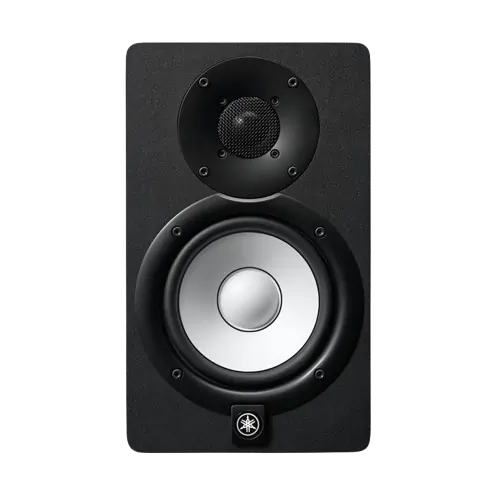
This monitor doesn’t flatter your music. It isn’t trying to. The signature white cone is the visible clue, and the sound delivers exactly what it promises: flat, mid-forward, slightly bright. Problems in your mix show up the moment they exist.
You can dig into the full design philosophy on the official Yamaha HS Series page.
Build Quality
Solid, Inert, Professional
This speaker is built like a tool, not a toy. The cabinet is dense MDF with very low resonance. At 5.3 kg, it feels heavy and dead-still in your hand.
The matte enclosure looks businesslike, not fashionable. That’s the point.
Connections That Mean Business
Connectivity stays properly professional:
- Balanced XLR (XLR3-31) input
- Balanced 1/4″ PHONE input
- A center-detented level control clicking to +4 dB for pro gear
How the HS5 Actually Sounds
The Midrange Rules Everything
The Yamaha HS5 lives and breathes through its midrange. The 5″ white cone delivers a clean, articulate, forward midband that makes vocals, snares, guitar bodies and lead synths impossible to hide.
If one element is masking another, the speaker shows you instantly.
A Tweeter Built to Reveal
The 1″ dome tweeter (crossed at 2 kHz) gives you a bright, extended top end. You’ll hear cymbal detail, sibilance, breath noise and reverb tails with surgical clarity.
This is an analytical tweeter, not a polite one. For mixing, that’s gold. For long casual listening in an untreated room, it can feel fatiguing. Independent lab measurements confirm this voicing in the Sonarworks HS5 measurement review.
Bass: Honest, Not Huge
Where the HS5 Stops
The Yamaha HS5 reaches down to 54 Hz at -10 dB — exactly right for a tight 5″ cabinet. The rear port handles the low end cleanly.
Sub-bass below 50 Hz simply isn’t there.
Pair It With a Sub
Producing hip-hop, bass music or EDM? Add a subwoofer — Yamaha’s HS8S is the natural match.
For vocals, acoustic music and podcasts where the kick-and-bass action sits above 50 Hz, the bass stays tight, tuneful and never bloated.
Tuning the Speaker to Your Room
This monitor gives you two simple, powerful controls.
ROOM CONTROL — a low-shelf filter (0 / -2 dB / -4 dB) below 500 Hz that tames bass buildup near walls and corners.
HIGH TRIM — a ±2 dB top-end shelf to soften or sharpen the tweeter.
Yamaha recommends placing the monitor at least 1.5 m from walls. In a treated room, you’ll rarely touch these controls. In a typical bedroom studio, ROOM CONTROL at -2 dB is usually the right call. For deeper guidance on placement and treatment, Sound On Sound is an excellent professional resource.
Living With the HS5
A Narrow Sweet Spot
These monitors are built for nearfield listening at around 1 m. Move off-axis and the imaging collapses faster than wider-waveguide designs like JBL.
It Demands Quality
Feed the speaker a clean interface and well-recorded material and it sings. Feed it a noisy chain or poor recordings and it will be brutally unflattering — because that’s exactly what it’s built to do.
Wrapping Up
The Yamaha HS5 is for producers and engineers who want a monitor that tells the truth and forces better decisions, the Yamaha HS5 is one of the most consistently recommended speakers in the industry.
Flat midrange. NS-10M heritage. Solid build. Pro connectivity. This is a tool that grows with you — from bedroom to project studio to professional room. And the mixes you make on a pair of these will translate almost anywhere.