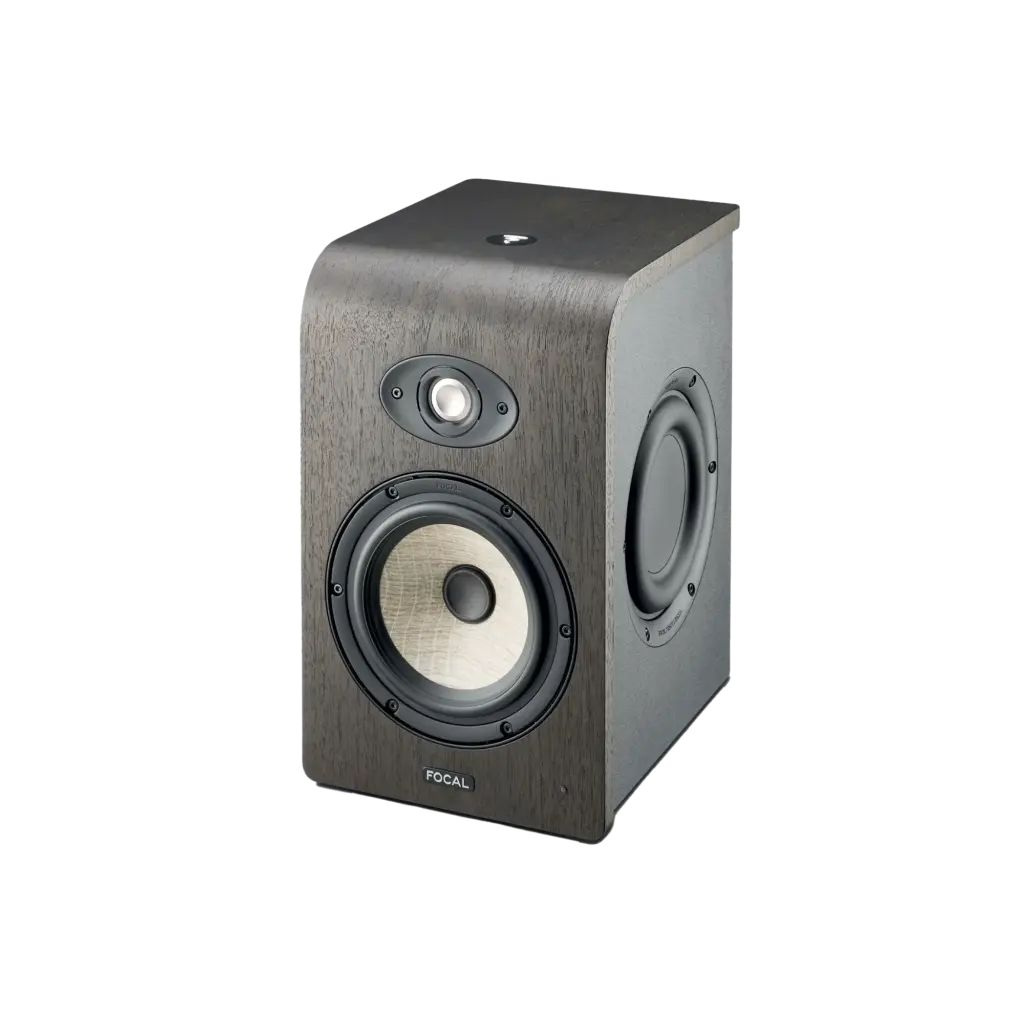
Focal Shape 65 Review: A Brutally Honest Studio Monitor
Where the Shape 65 Fits
The Focal Shape 65 sits at the top of Focal’s Shape line — a bridge between the entry-level Alpha series and the high-end SM6/SM9 reference monitors.
It’s a two-way active nearfield built on Focal’s signature pairing: a 6.5″ Flax sandwich cone (French flax fibre between two thin sheets of fibreglass) and a 1″ “M”-shaped aluminium-magnesium inverted dome tweeter. The bi-amped Class AB design pushes 80 W to the woofer and 25 W to the tweeter, all housed in a real walnut-veneer MDF cabinet, built in France.
Pick one up and the weight hits you first. At 8.5 kg per monitor, this is a seriously built speaker, with finish quality well above its price. Full specs live on the official Focal Shape 65 page.
The Clever Cabinet Design
No Port — Two Passive Radiators
The most interesting decision here is the lack of a bass port. Instead, Focal fits two passive radiators — same diameter as the woofer — one on each side of the cabinet.
A passive radiator works like a bass reflex port, but without pipe resonance or port turbulence. The payoff for home producers is real: you can place this monitor much closer to a rear wall without smearing the low end. In untreated rooms, that matters.
The Trade-Off
The side-firing radiators lock you into vertical orientation only. Lay these speakers on their sides and you’ll fire bass straight at your other monitor.
How the Focal Shape 65 Sounds
A True Analysis Tool
This is a genuine analysis tool. The woofer holds an undistorted, honest midrange across different monitoring levels, and the stereo image is wide and precise. Even at the recommended one-metre distance, the sweet spot is generous and instruments sit in clear, defined positions.
Detailed, Faithful, Mid-Forward
Frequency balance is exceptional. The highs sparkle and reveal detail without the metallic edge of cheaper studio monitors. The mids stay balanced and faithful.
Focal’s house sound is mid-forward, so vocals, snares and lead instruments tend to sit correctly almost by default. Bass is taut, tuneful and well-extended rather than huge — controlled low end that’s often exactly right for smaller, less-treated rooms.
The Honesty Cuts Both Ways
This is not a flattering monitor. The tweeter is honest to a fault — bad recordings, harsh cymbals and cheap synths will sound bad. Timing isn’t its strongest trait either, which can make live performances feel slightly less locked-in. For mixing, that’s the point. For casual listening, just know it going in. Industry reviewers at Sound On Sound have noted the same revealing character across Focal’s range.
Practical Niggles to Know
A few real-world quirks, all manageable:
- Auto-standby — at low levels the monitors can drop into standby and need a volume push to wake. Annoying during quiet, late-night sessions.
- No input gain trim — and the rear EQ pots are continuous, not stepped, so recalling exact settings between sessions is fiddly. (Adjustable HPF at Full/45/60/90 Hz, ±6 dB bass shelf, ±3 dB 160 Hz LMF, ±3 dB HF.)
- Run-in period — give them around 10 hours before the bass fully opens up. Out of the box they sound tight and a little flat. Don’t panic. Check our guide on this.
Connectivity and Mounting
Inputs are XLR (balanced) and RCA (unbalanced) — note there’s no TRS jack, which surprises users coming from cheaper gear.
Threaded inserts on the back and base open up wall, ceiling and stand mounting, and four adjustable rubber feet let you tilt the speakers to fire properly at your ears. You can compare configurations on the Sweetwater product listing.
Wraping Up
As a mixing and mastering tool for a small or medium project studio, the Focal Shape 65 is one of the most revealing monitors at this price.
It’s an analysis tool. That’s its greatest strength — and the very thing that makes it the wrong choice for anyone who wants their music to sound flattering rather than accurate.