Kali Audio LP-6 2nd Wave Review: Reference Accuracy on a Budget
Looking at the Kali Audio LP-6. Kali Audio founded in 2018 by audio veterans with a clear mission — serious monitors without the serious price — Kali Audio made its name fast. The Project Lone Pine LP-6 was the debut, and it routinely embarrassed speakers costing two or three times as much. The Kali Audio LP-6 2nd Wave, released in 2021, sharpened the original with a 12 dB lower noise floor, 3 dB more output, smoother highs and better DSP. The result is one of the most over-performing monitors you can buy.
Build and the Front-Firing Port
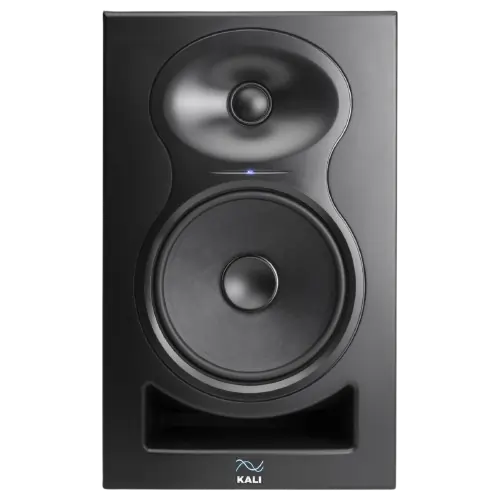
The build is dense and deliberate. At 7 kg per monitor, the Kali Audio LP-6 has real mass — vinyl-wrapped MDF with optimised internal bracing and a front-firing low-noise port designed using computational fluid dynamics to kill port chuffing. That front port matters: it means you can place the speaker near a wall without the smearing and bloat that ruin rear-ported designs in small rooms.
How the Kali Audio LP-6 Sounds
Accuracy First
The Kali Audio LP-6 is defined by accuracy. Whatever’s in your mix is what comes out — no boost, no flattery, no added character. The response is genuinely flat from the lows through the mids, and the 2nd Wave’s improved DSP smooths the top end further. It’s reference-grade in its honesty, yet never sterile or dull to listen to.
3-D Imaging Waveguide
The headline feature is the 3-D imaging waveguide around the 1″ textile dome tweeter. It controls dispersion so the recording’s spatial information survives to your ears, giving a deep, well-defined soundstage. Vocals sit in precise positions, reverb tails extend in three dimensions instead of collapsing onto the stereo line, and layer separation is exceptional for the money — the sort of imaging you normally meet on monitors three or four times the price.
Bass and Output
The 6.5″ optimised paper woofer pairs with a big voice coil and magnet for more extension and headroom than the 5″ competition. Bass reaches 47 Hz (±3 dB) and 39 Hz (-10 dB) — real sub-bass for a nearfield monitor at this price. It stays clean and low-distortion, with peak SPL of 115 dB giving ample headroom for hip-hop, electronic music or anything where the low end carries the track. With the front port, that bass stays tight even in small rooms.
A Dead-Silent Noise Floor
The other revelation of the 2nd Wave is silence. The original Kali LP-6 was already quiet for a budget monitor; this one is dead silent with no signal playing — no hiss, no buzz. It’s a real practical win in quiet sessions, and another reason the speaker adds none of its own colour to your mix.
Connectivity and Room Tuning
Connectivity is generous: balanced XLR, balanced 1/4″ TRS and unbalanced RCA, with switchable sensitivity (+4 dBu for pro gear, -10 dBV for consumer sources on RCA). Boundary EQ runs off rear dip switches with eight presets, tuned by Kali at The Village Studios in LA for common placements — on stands, on a desk, against a wall, in a corner, and so on. Extra LF and HF trim switches add further control. Dip switches aren’t as slick as soft-key DSP, but the settings are precise and don’t drift.
Two Things to Watch
A couple of practical notes. First, Kali warns that the vinyl wrap is sensitive to heat and humidity — direct sun, moisture or sustained humidity above 65% can cause peeling, and that’s not covered under warranty, so keep them in a climate-controlled space. Second, at 7 kg each the Kali LP6 is heavier than most small budget rivals, so use stands rated for the weight.
Who Should Buy the Kali Audio LP-6?
Recommended listening distance is 0.5–2.5 m, which makes the Kali Audio LP-6 ideal for nearfield mixing in small to medium rooms. Need more for a bigger space? Kali’s LP-8 (8″ woofer) is the natural step up. But for most home and project studios, this monitor nails a sweet spot of size, output and accuracy that’s almost impossible to beat under £400 a pair.
You can see the full upgrade details on Kali’s official 2nd Wave page, and the independent Klippel measurements at Erin’s Audio Corner back up the performance. This is the budget monitor every producer should audition before spending more.