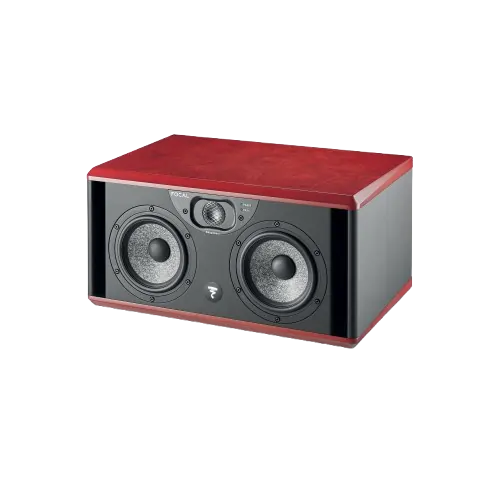
Focal Twin 6 Review: Reference-Grade Mid-Field Monitoring
The Focal Twin 6 — officially the Twin6 ST6 — is the latest version of one of Focal Professional’s flagship mid-field monitors. It evolves the long-running Twin6 Be with a refined cabinet, updated electronics and the sharper ST6 look. Sitting at the top of Focal’s pro range alongside the Solo6 and Trio6, it inherits the brand’s most advanced acoustic tech: a 2.5-way architecture, a Beryllium tweeter and W composite cones — the same technologies you’ll find in Focal’s high-end hi-fi speakers, not consumer-grade compromises.
A Cabinet Built Like a Tank
The cabinet is substantial in every sense. At 50 cm wide, 25 cm tall and 34 cm deep, the Twin 6 is built for horizontal placement on a console bridge or wide stand — not a small desktop. It’s thick, internally braced MDF with the signature cherry veneer side panels that have been a Focal hallmark for years, and the build is flawless. At 22 kg each, it feels rock-solid and inert; you simply won’t hear cabinet resonance from a structure this rigid.
The 2.5-Way Design Explained
The 2.5-way dual-woofer layout is the key choice that sets the Focal Twin 6 apart from a conventional 2-way. Two 6.5″ W composite cones flank the central Beryllium tweeter.
Dual W Composite Woofers
One woofer works full-range as the mid/bass driver; the other handles only 40–150 Hz, adding low-frequency reinforcement. The payoff is bass with more dynamic range and lower distortion than a single woofer manages — without the mid-band masking a true 3-way can introduce. A rear switch lets you choose which woofer takes the mids, so a pair can be mirrored for left/right placement.
The W cone itself is Focal’s sandwich construction: two layers of woven glass fibre bonded to a foam core. It’s light enough for fast transients, stiff enough to control the bass, and well damped for low distortion across the range.
The Beryllium Tweeter
Beryllium is far lighter and stiffer than aluminium or titanium, so the inverted-dome tweeter reaches up to 40 kHz with very low distortion and superb transient detail. It’s mounted using TMD (Tuned Mass Damper) suspension, which cuts distortion in the critical 1–3 kHz region by roughly half versus conventional designs.
How the Focal Twin 6 Sounds
This is a monitor defined by transparency, midrange neutrality and imaging precision. The midrange is open and uncoloured — vocals, snares, lead instruments and reverb tails all sit exactly where they belong. Stereo separation and spatial detail are reference-grade, revealing layer separation and depth that lower-tier monitors can’t match. The Beryllium tweeter stays articulate and fast without turning harsh, and the dual-woofer bass is punchy, extended and tightly controlled even at high volume.
Focus Mode: A Built-In Translation Check
Focus mode is one of the most useful features on any pro monitor. Triggered by an optional footswitch (via the rear 1/4″ jack), it mutes the bass driver and tweeter, leaving only the mid-bass driver running full-range. That gives you an instant Auratone-style single-driver check — hear how a mix holds up on a phone, laptop or small consumer speaker without swapping monitors. For anyone chasing translation, having that on a footswitch is a genuine workflow win.
Room Tuning and Controls
The control set is thorough. The rear panel offers a switchable high-pass filter (Full / 45 / 60 / 90 Hz) for use with a sub or to trim sub-bass below your room’s limit. You also get an LF shelf (±3 dB), a 160 Hz parametric LMF EQ (±3 dB) to tame desk and console reflections, and an HF shelf (±3 dB) for the tweeter. Sensitivity switches between +4 dBu pro and -10 dBV consumer levels, and auto-standby can be turned off.
Power and Amplification
The amplification is unusual and worth understanding. Each mid-bass driver gets 70 W of Class G — a hybrid that pairs Class AB sound quality with better efficiency — while the Beryllium tweeter runs on a 50 W Class AB amp for maximum fidelity where it matters most. Max SPL is 112 dB peak at 1 m, ample for mid-field listening in a typical pro room.
A Few Things to Know
Some practical points. The XLR-only input means no direct connection to consumer gear — you’ll need an interface or balanced converter. There’s no input gain trim beyond the sensitivity switch, so precise level-matching between the pair takes care upstream. And the sheer size rules it out for small home studios; a pair will dominate a desk and needs real clearance to image properly.
Who Should Buy the Focal Twin 6?
For professional recording, mixing and mastering rooms — or serious home producers with the budget and the space — the Focal Twin 6 is one of the best studio monitors money can buy. The mix of W composite cones, Beryllium tweeter, 2.5-way design and Focus mode delivers a level of transparency and flexibility that justifies the investment, and explains why the Twin 6 turns up in so many of the world’s top studios.
You can read the full specs on the official Focal ST6 page, and MusicRadar’s hands-on Focal Twin 6 review backs up the verdict.